Per Capita, December 2025
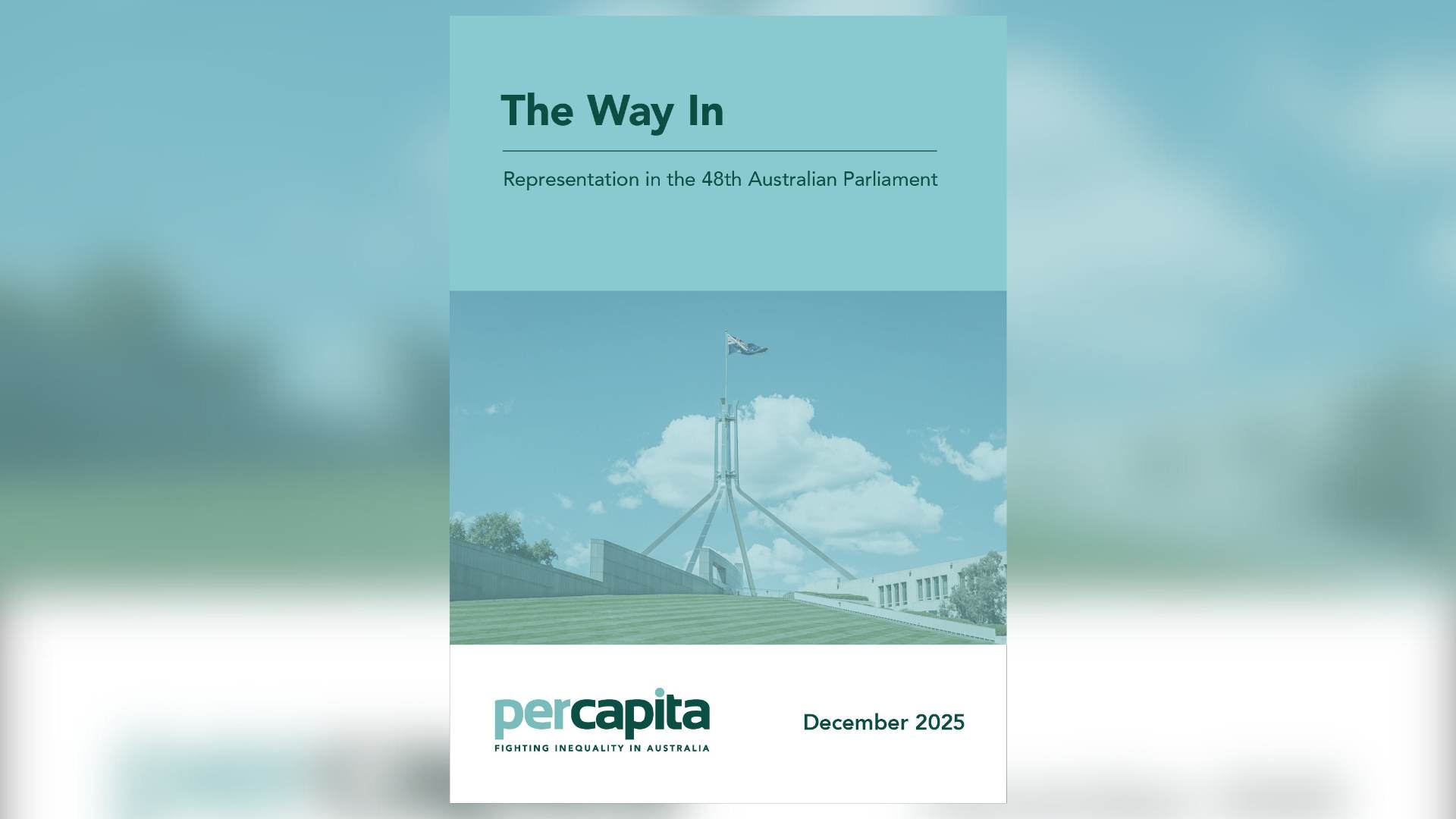
This edition of The Way In examines the 48th Australian Parliament, elected in 2025. It follows Per Capita’s analyses of the 45th, 46th and 47th parliaments, and continues to trace the pathways by which Australians enter political life. It explores representation through the lenses of gender, Indigeneity, cultural and ethnic background, education, age and employment, comparing those who sit in our national legislature with the people they serve.
Key findings:
- Gender parity is closer than ever. Women now make up 49.6% of federal parliamentarians, the highest share in history. For the first time, the Federal Cabinet has a female majority (52.2%).
- First Nations representation remains above population share. Nine Aboriginal and Torres Strait Islander parliamentarians (4%) sit in the 48th Parliament, but without collective mechanisms their influence depends heavily on party alignment.
- Cultural diversity has broadened, but gaps persist. Parliament has become less Anglo-Celtic, yet large communities such as Chinese Australians remain under-represented.
- Overseas-born Australians are under-represented in Parliament. Only 12.8% of MPs and Senators were born overseas, compared with 29.3% of the population. The constitutional prohibition on people with dual citizenship sitting in Parliament is a significant barrier for overseas-born Australians standing for federal office.
- Parliament is ageing compared to voters. MPs and Senators are dominated by Generation X and Baby Boomers, while Millennials are under-represented and Gen Z almost absent. The median age of parliamentarians is about a decade older than the median age of voters.
- Educational background is elite. Nearly one in three MPs and Senators hold postgraduate degrees (compared with 6.5% of Australians). Parliament is overwhelmingly university-educated relative to the general population.
- Political pathways are narrow. Almost all MPs and Senators came from managerial or professional roles before entering Parliament, leaving vocational and working-class experiences largely absent.
Read the full analysis

 Read
Article
Read
Article 
 Listen to
Audio
Listen to
Audio