
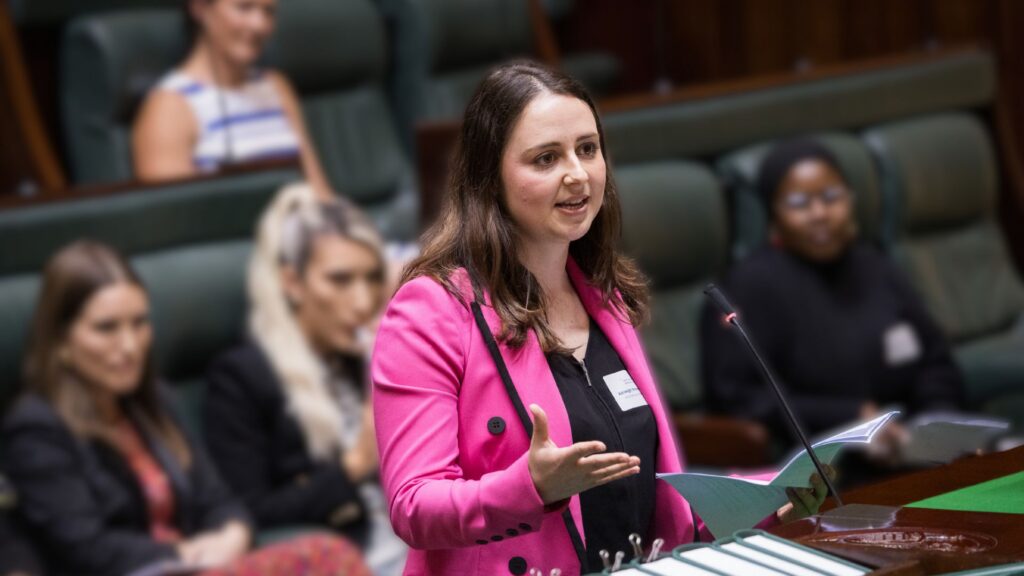
By Ashleigh Streeter-Jones, Founder and CEO of Raise our Voice Australia and an alum of the Victorian Pathways to Politics for Women program. With contributions from Ellie Mueller, Community Engagement Adviser, Raise Our Voice Australia.
Ashleigh Streeter-Jones, Founder of Raise Our Voice Australia, shares her tips for young people interested in politics.
Growing up, we often had discussions over dinner about what was happening in the world. Whether it was a story on the evening news, a conversation one of my family members or I had with someone else, or something we’d done that day, nothing was off the table – including politics, which we discussed passionately and curiously. My parents always encouraged my sister and I to share opinions, and instilled the knowledge that we were people who could create positive change.
This meant that from a young age, I was engaged with issues and motivated to take action, particularly around politics. Despite this, I didn’t have a good idea of where to start, or even where to connect with like-minded people around my age who also wanted to make a difference.
Through my work with Raise Our Voice Australia, I’m lucky to connect to passionate young people (particularly young women and gender diverse people) around the country who are eager to make a difference through political engagement, but who might not necessarily want to run for office. Fortunately, there’s many ways to get involved outside of this pathway! These are some of the tips I give to young people about where to start.

About Ashleigh Streeter-Jones
Asheleigh is Founder and CEO of Raise our Voice Australia, a youth-led not-for-profit organisation that empowers young women and gender-diverse people to shape politics and policy by building confidence, skills and opportunities to have their voices heard.
Described by Forbes Magazine as a “youthful visionary”, Ashleigh (she/her) has worked in youth advocacy and campaigns for 10 years. ACT Woman of the Year 2018 and a Forbes 30 Under 30 listee, Ashleigh has been recognised as an Australian Financial Review 100 Women of Influence, was a recipient of the Global Citizen Youth Leader award, and was a Victorian Young Australian of the Year finalist in 2024.
Ashleigh has represented young people, gender equality and young women and gender diverse people in politics and the public sector at home and abroad, having presented on the topic to both domestic and global organisations including the World Economic Forum and World YMCA. Ashleigh has attended the Commission on the Status of Women at the United Nations, and in 2023, she was selected as one of 50 young leaders to attend the World Economic Forum’s annual meeting at Davos.
In 2022 she joined former Prime Minister Julia Gillard on her Not Now Not Ever tour, and hosted an event with US Secretary of State Anthony Blinken. Ashleigh is an experienced policy practitioner, and holds a Bachelor of Arts (Hons) (Politics/ IR) from Monash University and a Masters in Diplomacy from ANU.
Ashleigh is an alum of the 2023 Victorian Pathways to Politics for Women program.

About Ellie Mueller
Ellie Mueller is a former political staffer, writer, and youth advocate working at the intersection of politics, policy, and community engagement. She is the Community Engagement Advisor at Raise Our Voice Australia and previously worked as an Electorate Officer in the Australian Government. Ellie holds a BA in International Relations, Middle East Studies, and History from Deakin University and is a Global Citizenship Award recipient.
Before you get started
1. Think about the issue you’re passionate about, and the change you want to make on it
This will serve as your why – and it doesn’t have to be a single issue (for passionate people, our interests are often a long list and are very interlinked!) For example, if you care about climate change, do you want the government to invest more in renewables? Which level of government is best placed to act, what does that look like in practice, and how do you encourage them to act? Once you’ve narrowed it down, this focus will help you identify opportunities to engage with politics and make an impact.

2. Think about how you might want to engage, the skills you have, and the skills you’d like to develop
Political engagement is a spectrum, and each way of showing up contributes to positive community change. For some people, political engagement might be running for office or leading a campaign. For others, it might be engaging with an issue-based organisation, being part of a team, or even showing up to events such as protests, talks, webinars, or workshops.
No matter your skillset, there’s a place for it in political engagement! Whether you’re a communications whiz, event organiser, great with people (perfect for a candidate, stakeholder manager, volunteer coordinator), a policy wonk, content generator, legal beagle, love creative problem solving, an expert systems-navigator, or are just starting out, there’s an opportunity which will suit you. Whatever you choose, think about what you can sustain over the long term – after all, political change rarely happens overnight and keeping ourselves well is one of the best things we can do to ensure lasting change.
3. Think about the time you want to put towards your engagement
In some seasons of life we have more time than we do in other seasons, and that’s totally fine! If you only have an hour a week, think about the activities which you can fit into that hour – this could be as simple as listening to a podcast, reading information about politics or a specific issue, joining a meeting, participating in an event, or having a conversation with someone about an issue. If you have more time available, you might choose to volunteer with an organisation or sign up for an opportunity which requires a more ongoing commitment.
4. See what’s already out there!
No matter where you’re at on your political journey, engaging with an organisation can be a great way to connect with others, develop your skills, and learn more about how to drive political change.
There are many excellent organisations doing impactful work and they’re often looking for volunteers. Once you’ve chosen the cause you’re passionate about, you can research organisations doing targeted work to shift the dial on that issue through political engagement.
Some organisations I admire are FORE Good, Democracy in Colour, the Australian Youth Climate Coalition, Pathways to Politics for Women (of course), Folio Collective, Foundation for Young Australians, Foundations for Tomorrow, Tomorrow Movement, Country to Canberra, Gen Vic (for those in Victoria), ANTAR, and I may be biased, but Raise Our Voice Australia.
Unions are also very politically active organisations and engage across a variety of issues, providing another great avenue for engagement. Many of these organisations have newsletters you can sign up to or social media accounts you can follow, which are useful ways to stay across the opportunities they offer.
There are often programs happening at a very local level too, so don’t forget to check what’s happening in your community and the areas close to you.
5. Connect with the people doing great work in the space
It sounds simple, but being part of active communities is an excellent way to connect with opportunities and to take action. Following social media accounts, joining WhatsApp, Discord or Facebook groups, turning up to events and volunteering are all great ways to find your people, learn more about what’s out there, and develop your skillsets.
6. Join a workshop
Many organisations (including Raise Our Voice Australia) run online workshops which allow you to develop your skills, deepen your knowledge, and connect you with opportunities. This is a great option if you’re first starting out, as it allows you to learn more about the work being done and decide whether the nature and approach of an organisation is a good fit for you.
7. Apply for your Youth Parliament
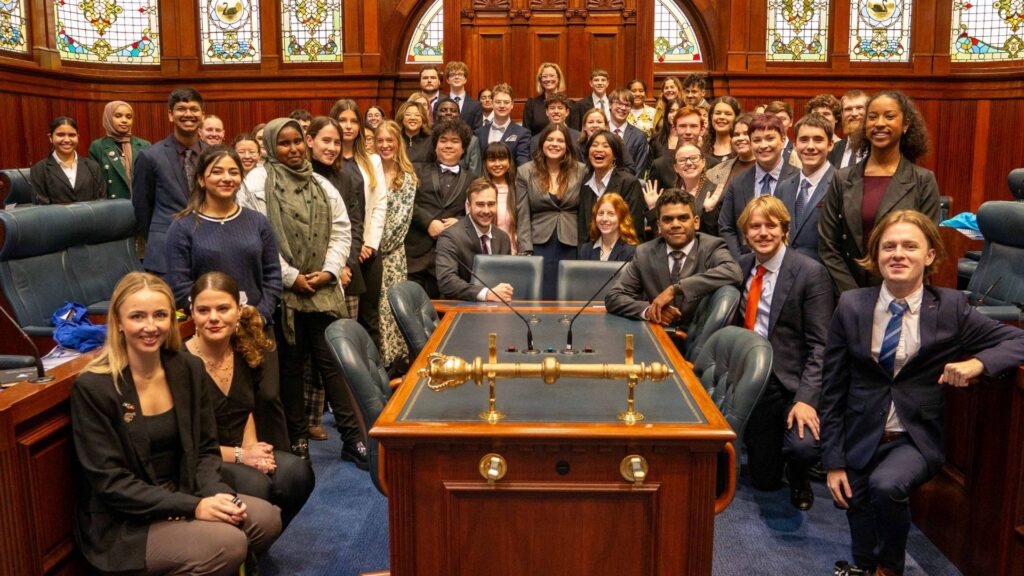
Youth Parliament is a program run by the Y, in which young people become the youth member for their electorate. The programs run in each state and territory, with the National Youth Parliament sitting for the first time in August 2026. Youth parliaments run over several months, ending in a week-long camp and debates at Parliament House. You can find more information here.
Big “P” political pathways
8. Join a political party
Many political leaders and their policies start from the same place: political parties. Party members elect delegates to national conferences, determine the policies to take to elections, and support candidates through campaigns, stakeholder management and more.
A party may not reflect all of your views and positions, and that’s okay – but their policies don’t shift without people getting involved. It’s also a great way to connect with your community, and like-minded, engaged people while building your skillset.
Many political parties also offer a youth structure – such as Young Labor, Young Liberals or Young Greens. Within these structures there are a number of leadership roles, which you can apply for once you’ve joined. This is another great way to have an impact, and to have a say over the policies put forward by the party.
9. Volunteer on a political campaign
You don’t have to be a party member to volunteer on a political campaign. Volunteering can span doorknocking (a great way to hear what really matters to voters), phone banking (hearing from constituents and fundraising), mobile listening posts (where the candidates are out in the community to hear what matters to constituents), supporting and attending events such as forums (where members participate in public debates to both listen to constituents, answer questions and share their positions on issues) and debates with other candidates running for the seat, volunteer management, fundraising and more.
If there’s a candidate you admire, get in touch with their campaign team (either through their website or social media pages) and see where you can help out – this is also a great avenue to build your skills and get some experience if you’re interested in running for office in the future. With the Victorian election around the corner and the New South Wales election not too far away, the timing for election volunteering is perfect!

10. Look up your local representative and get in touch
Sometimes we forget that our local representatives (state members, federal members in the upper house and lower house, and local councilors) are actually there to represent what matters most to us – and they can’t represent our views unless they know what they are! Connecting with your local member to share what you’re passionate about or the actions you’d like them to take is a great way to drive action on an issue. Many parliamentarians have Youth Advisory Councils or similar bodies. Connecting in with your local member will make sure you know when applications open.
You can look up your electorate on the AEC website by postcode or suburb, and your state/territory electorate through the local electoral commission, and your council by doing a quick online search – and, don’t forget your upper house members! Once you’ve found your local member, you can send them an email and ask to set up a meeting (they prefer this over a message on social media), or you can find a time when they’ll be out in the community and connect with them there.
11. Work or intern with a member of parliament
Members of parliament have a team of staff that support their work in the electorate. While the roles in the office may vary slightly, this team is there to help constituents, and no two days are the same. Two common roles are Electorate Officers and Media Advisers.
The role of an Electorate Officer is highly varied. From supporting the elected member to be out in the community to solving problems for constituents (for example, challenges with Centrelink and the NDIS, or helping you take action on areas such as education, parks, public transport, roads and more), Electorate Officers play a pivotal role in helping the community.
Many offices also have Media Advisers who manage social media, write speeches, media releases, and work with the media on behalf of the elected member. Media Advisers may also travel to parliament to support the elected member during sitting weeks.
Some offices also accept interns or people doing work experience. Getting in touch with your local parliamentarian’s office to introduce yourself and express an interest is a great way to create the opportunity and learn more about how it all works behind the scenes.

No matter which pathway you choose, you’ve already achieved the first step – you’ve decided to take action. Congratulations!
It’s this decision which will make your community a better place.
All the best for your political journey and most of all, enjoy it!
– Ashleigh


 Access
Toolkit
Access
Toolkit 
 Read
Report
Read
Report